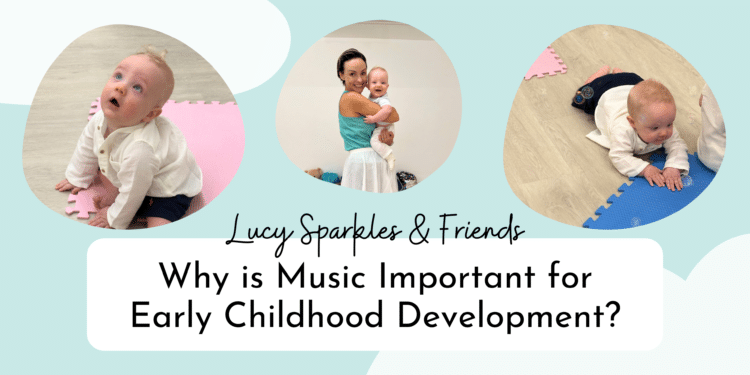
George has been coming to our Lucy Sparkles
Baby Sparkles music classes since he was almost three months old. He is a very laid-back and friendly baby, so I often have the privilege of a cuddle after class while I chat with his delightful mum. George turned one a few weeks ago, and something amazing happened during the first class after his birthday.

In our classes, we do a lot of
call and response activities with the parents. In one of these activities, I sing a short phrase as a puppet monkey, “Hello, everyone!” and the parents sing back using an identical melody but with different words: “Hello, Mrs Monkey.”
You might wonder why I get the parents to sing on their own, given that the class is for the babies, not the parents! Babies learn to sing the same way they learn to speak, by mimicking what they hear around them.
When they see the teacher singing the ‘call’ and the grown-ups copying the same melody in their ‘response’, they immediately recognise
pitch matching as part of human communication. And if this is done regularly with babies, they begin to
pitch match and
sing in tune from the very first time they start to sing. I’ve witnessed this with both of
my children, who could sing perfect melodies using the syllable ‘wah’ before they could even talk.
My approach to teaching is heavily influenced by
Zoltán Kodály, the Hungarian composer and music educator whose work inspired me to become a music teacher. Kodály emphasised that
call and response songs for kids are one of the most effective ways to develop a child’s
inner hearing (a kind of auditory imagination that allows them to hear and process music internally before singing or playing it). It is the same mechanism that causes pop songs to get ‘stuck in your head’. Babies who are consistently exposed to this practice develop a deeper understanding of
pitch,
rhythm,
pulse (steady
beat) and
melody, the foundational elements of
musical development, much earlier than their peers.
Anyway, back to George. It was the first class after his birthday. I took out the monkey puppet, and before I had even opened my mouth, he sang “he-llo” using the so-mi interval that we always sing. Now, it’s impressive enough that he had the linguistic ability to sing ‘hello’, but what is even more extraordinary is the musical skill involved in what he did.
Firstly, the visual cue of the puppet activated his
inner hearing, allowing him to anticipate the interval before hearing it aloud. Then, he successfully reproduced the exact interval that we always sing. This is no small feat for a 12-month-old baby. It demonstrates that through consistent
repetition and exposure, George had internalised the musical pattern and was able to recall and reproduce it with accuracy.

Why is this Important for Early Childhood Development?
George’s experience highlights the powerful impact that early music education can have on a child’s development. Here’s why:
1. Developing Pitch Accuracy and Musical Memory
Kodály’s approach emphasises the importance of using simple intervals like so–mi to develop a child’s
inner hearing. We begin with the so–mi interval because it is the easiest for the human voice to sing. You’ll notice that it appears frequently in playground chants (like
‘See Saw Up and Down’), which children themselves have made up over generations. When George recognised the puppet as a cue and reproduced the so-mi interval, he demonstrated a high level of
musical memory and
pitch recognition, which develops through consistent exposure and repetition, highlighting the
benefits of music for children at an early age.
2. Building Auditory Processing and Language Skills
Children who engage in
call and response music activities from a young age develop stronger
auditory discrimination, which is essential for
language development. Babies mimic speech patterns in the same way they mimic musical intervals. By matching
pitch and
rhythm, babies like George strengthen the neural connections between music and language, contributing to better
phonological awareness,
reading skills, and overall
brain development.
3. Repetition Reinforces Neural Pathways
Repetition strengthens neural pathways, making responses more automatic over time. Kodály believed that frequent repetition of simple musical patterns helps embed musical concepts in the brain, leading to greater accuracy and confidence when children begin to sing independently. George’s ability to anticipate and replicate the melody demonstrates how repeated exposure builds this foundation.
4. Supporting Emotional and Social Connection
Call and response songs for kids are also a social interaction that reinforces communication skills and bonding between children, parents and teachers. The act of responding musically mirrors conversational turn-taking, a key precursor to effective communication. George’s joyful participation highlights how music strengthens these bonds and promotes
emotional security.
5. Establishing Early Musical Literacy
Kodály’s philosophy advocates that singing should precede reading and writing music, just as children learn to speak before they read. By experiencing and internalising
musical intervals and
rhythms before formal instruction, George is already building the foundation for future
musical literacy.
In essence, George’s ability to sing the interval shows how early, consistent musical exposure can accelerate the development of
pitch matching,
inner hearing, and overall
musicality in young children. These carefully planned early experiences lay a strong foundation for future musical learning, such as learning an instrument or dancing. They also support broader areas of development — including
language skills,
cognitive development,
social-emotional growth, and overall
brain development in early childhood.
George’s Mum has thoroughly enjoyed our classes along with George stating, “We have been coming to Lucy Sparkles since George was 3 months old and he loves every minute of it. The sessions are interactive and engaging with new and familiar songs each week. The singing elements have really helped George with his rhythm and pitch skills. Lucy Sparkles is such a warm and social environment for George which is why we have been coming for so long.”
Now that you know more about the
benefits of music for children, why not join one of our
music classes? We offer drama, music and dance classes for young children in
London,
Singapore and
Australia. Learn more about our story and what makes our classes so special — and catch up on all the latest from Lucy Sparkles & Friends, including more on why
music is important for early childhood development, over on Instagram
@lucysparkleshq. 
No Comments Yet